Texas Bluebonnets
Our Look At The State Flower Of Texas
The state flower of Texas is the bluebonnet.
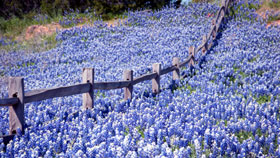
The bluebonnet is to Texas what the shamrock is to Ireland, the cherry blossom to Japan,
the lily to France, the rose to England and the tulip to Holland.
- Historian Jack Maguire
Bluebonnets in Texas are a major Spring attraction.
They grow along many state highways, and are truly spectacular.
Bluebonnets typically bloom until the end of May
when temperatures get warm. They tend to peak in mid-April.
Blooming along with the bluebonnets are Indian paintbrush, Indian blanket and coreopsis.
Texas Bluebonnet History
 Wildflowers Across Texas
Beautiful Laurence Parent photography makes this book a first-class tribute to the
beauty of Texas Wildflowers
Special Sale
 Touring Texas Gardens
Walk through our state's best kept secret - its public gardens!
Original review
 Wildflowers of Texas
Perfect guide for the Lone Star State's many wildflowers found everywhere.
Original review
As the state flower of Texas, bluebonnets have an interesting history.
Texas actually has five state flowers. They are all bluebonnets. Here is how it happened.
In the spring of 1901, the Texas Legislature got down to the serious business of selecting its official
state flower. The ensuing floor debate was hot and heavy. One state legislator spoke emotionally in favor of the cotton
boll since cotton was king in Texas in those days.
Another, a young man from Uvalde, extolled the virtues
of the cactus so eloquently, noting the hardy durability of the plant and the orchid-like beauty of its
flowers, that he earned the nickname of "Cactus Jack" which stuck with him for the rest of his life.
He was John Nance Garner, and later became vice president of the United States under Franklin D. Roosevelt.
At the end of the day, the National Society of Colonial Dames of America won. Their choice was Lupinus
subcarnosus ("generally known as buffalo clover or bluebonnet," stated the House resolution) and it was
passed into law on March 7 without any recorded opposition.
Thus began the Bluebonnet Wars.
Lupinus subcarnosus is a dainty little plant which paints the sandy, rolling hills of coastal and
southern Texas with sheets of royal-blue in the early spring. But some folks thought it was the least
attractive of the Texas bluebonnets. These individuals wanted Lupinus texensis, which is a
showier, bolder
blue beauty which
covers most of Texas and gives inspiration to many an artist.
So, off and on for 70 years, the Legislature was encouraged to correct its oversight. But legislators
weren't about to get caught in another botanical trap, nor did they want to offend the
advocates of Lupinus subcarnosus. As seen often in the political world, a solution was hammered out.
In 1971, the Legislature handled the dilemma by adding the two species together, plus "any other variety of
bluebonnet not heretofore recorded", and lumped them all into one state flower.
Among the many things the Legislature did not know then was that the state of Texas is home to three
other species of Lupines. The umbrella clause makes all five of them the state flower. And, if any new
species are discovered, they automatically will assume the mantle of state flower as well.
Texas is so large and grand, that we cannot have just one state flower.
The five state flowers of Texas are:
- Lupinus subcarnosus, the original champion and still co-holder of the title, grows naturally in deep
sandy loams from Leon County southwest to LaSalle County and down to the northern part of Hidalgo County in the
Valley. It is often referred to as the sandy land bluebonnet. The plant's leaflets are blunt, sometimes notched
with silky undersides. This species, which reaches peak bloom in late March, is not easy to maintain in clay
soils.
- Lupinus texensis, the favorite of tourists and artists, provides the blue spring carpet of Central
Texas. It is widely known as THE Texas bluebonnet. It has pointed leaflets, the flowering stalk is tipped with
white (like a bunny's tail) and hits its peak bloom in late March and early April. It is the easiest of all the
species to grow.
- Lupinus Havardii, also known as the Big Bend or Chisos Bluebonnet. The most majestic of the
Texas
bluebonnet tribe, it has flowering spikes up to three feet. It is found on the flats of the Big Bend country
in early
spring, usually has seven leaflets and is difficult to cultivate outside its natural habitat.
- Lupinus concinnus is a tiny little lupine, from 2 to 7 inches, with flowers which combine
elements of white, rosy purple and lavender. Commonly known as the annual lupine, it is found sparingly in the
Trans-Pecos region, blooming in early spring.
- Lupinus plattensis stretches down from the north into the Texas Panhandle's sandy dunes.
It is the only
perennial species in the state and grows to about two feet tall. It normally blooms in mid to late spring and
is also known as the dune bluebonnet, the plains bluebonnet and the Nebraska Lupine.
We have more bluebonnet photographs in a special set on our
Flickr account.
Have more bluebonnet pictures? Feel free to share them on our
message board.

Warning: include(../templates/footer_news.htm) [function.include]: failed to open stream: No such file or directory in C:\inetpub\txcook_sawyer\Texana\bluebonnets.htm on line 162
Warning: include() [function.include]: Failed opening '../templates/footer_news.htm' for inclusion (include_path='.;C:\php\pear') in C:\inetpub\txcook_sawyer\Texana\bluebonnets.htm on line 162