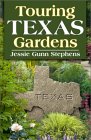
Touring Texas Gardens
by Jessie Gunn Stephens
Original book review by Steve Labinski
Columnist Jessie Gunn Stephens catalogs over 100 different gardens in Touring Texas Gardens.
Stephens has organized a new guidebook to the gardens in Texas
into her new book Touring Texas Gardens. At 270 pages, it is a handy reference book showing the reader how to
discover the "best kept secret in Texas." Unlocking this closely guarded information, she reveals that Texas has lots to offer in the way of gardens open to the public. She walks the reader through the elaborate Japanese
Gardens in Fort Worth and San Antonio, the Lady Bird Johnson Wildflower Center in Austin, as well as the cacti gardens
in Alamo or Hale Center. (A remote town in the Texas Panhandle)
Stephens, who writes regularly for the Sherman-Denison Herald Democrat, has obviously put
lots of time and car mileage into collecting complete information on gardens, located from Amarillo
to El Paso, and from Marshall to Victoria.
Stephens visits each one, detailing useful information for the potential visitor - fees, operating hours,
garden size, driving instructions, and lengthy descriptions of the gardens.
The first chapter of the book describes Texas gardening in general. She details getting through the
Texas summers, some native plants, and proper etiquette on visiting gardens, especially if they are on
private property. Stephens writes, "Time is a precious commodity, but today gardening for pleasure
is a lot more doable...Texans love to garden. And we get some of our best ideas by visiting public gardens
in our areas."
Texas Gardens Open to the Public
The gardens are organized into the five geographic regions of the state - north Texas,
east Texas, central Texas, south Texas and west Texas.
For north Texas, Stephens explains the dominent savannah and prairie of the countryside.
She also briefly lists a number of wild bird species frequently seen while driving,
and to keep the Eastern versions of a national bird field guide. Not only does
she chronicle gardens to visit, but also includes helpful information like birding advice,
which many people will find handy when making day-trips to these gardens.
The paperback book features numerous photos. The section on Austin's Zilker Botantical Gardens has four nice photographs
showing the oriental touch of the gardens. There are a number of photographs for the Weston
Gardens In Bloom in Fort Worth, plus many others.
Stephens also includes some lists at the back of the book of the "personal garden awards."
The Most Exuberant goes to the Antique Rose Emporium in Independence and the Most Passionate
goes to the Sunken Garden in San Antonio. Of course, the "Best Public Rose Garden in the USA,
Maybe The Whole World" is the Tyler Municipal Rose Garden.
Gardening can sometimes be tough in Texas. However, using Touring Texas Gardens, budding
gardners will love the tips, insight and beauty of the many gardens beautifying
the Lone Star State.
From Touring Texas Gardens
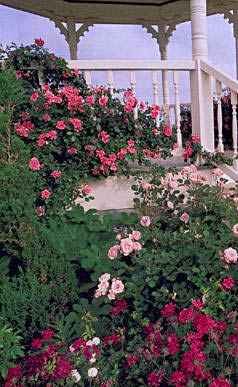
The Antique Rose Emporium
tops the book's list of
Don't Miss Gardens For Rose Lovers
Moody Gardens Rain Forest Pyramid
One Hope Boulevard
Galveston, Texas 77554
Fee: Adult: $8.95; Children: 4-12 $5.95; Seniors 65 and over $6.95. Fees do not include admission to
attractions other than the Rain Forest.
Accessibility: Excellent. Watch for a sign for the handicap drop-off ramp near the Visitor
Center.
Days and Hours: Open 10-6 Sunday-Thursday, 10-8 Friday-Saturday.
Garden Type: Glass conservatory, re-creating conditions in the world's rain forests.
Includes plants, fish, butterflies, birds, bats and insects from American, Asian, and African rain forests.
A 250-square-foot bat cave houses some 60 bats. A thick glass window into their
hanging boudoir lets you observe a wide range of activities.
Garden Size: Ten-stories, home to thousands of flora and fauna.
Themes and Special Features: Birds live loose here. Newly metamorphosed butterflies
are released into the air from the Hatching Hut twice a day, at 11 and 2. You may see an African
violet growing out of a crack in a rock that looks just like one your grandmother has in a pot
in her living room. Piranha and other fish indigenous to rain forest habitats
swim in the streams.
The Gardens: Moody Gardens is a colossal entertainment complex, encompassing three IMAX Theaters
including the kind with moving seats, a huge aquarium, beaches, restaurants, a 300-room
hotel, boat rides, and three brightly colored, pyramid-shaped buildings that dominate
the flat coastal plain for miles around.
It also has the most drop-dead gorgeous parking lot you will ever lay eyes on. And they don't
even seem to know it. The must take all those enormous plants and oleanders and hibiscus
and other exotic bloomery and shrubbery entirely for granted, I suppose. The exotic beauty of
this place knocked me off my feet. These outdoor plantings and the Rain Forest Pyramid
are what we will concern ourselves with here. But if you bring kids onto the property
don't expect to get away without exploring some of the other wonders, too.
After you've gawked around the parking lot for awhile, leave the
car in one of the many spots available and stroll through the grounds. Pass the ten-foot-tall turk's
cap. Take a photo of a Medjool date palm. Meander down smooth concrete paths on the south and
east sides of the Visitor Center. Enjoy the spectacular water features on the bay
side. Sit on the terrace and catch your breath before you venture inside.
If you've followed me here, you're now at the rear entrance to the Visitor Center. As you enter,
look ahead and to your right for the first of many treats - pink flamingoes viewed through a window
into their rain forest habitat. That's a taste of the good things to come, but you must
buy your tickets first, so head to your left and toward the front of the building to the ticket stand
before returning to enter the Rain Forest Pyramid.
(Partial Reprint of this listing)
Paperback: 270 pages
Publisher: Republic of Texas Press; ISBN: 1556229348 (July 2002)
Purchase Book on Amazon.Com
© 2013 Mesquite Management, Inc. -- ALL RIGHTS RESERVED.
Texana is part of the Texas Cooking website network.