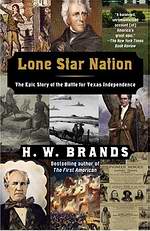
Book Review by Steve Labinski
H.W. Brands is a very good storyteller, bringing to life all the famous characters and events that walk through the founding of Texas. Despite years of tall tales,
movies and others taking liberties with the facts, on its own the story is a good one.
He begins by painting a picture of Moses Austin, a failed businessman who, like many others, was driven to this remote border province of Mexico.
Austin and his brother successfully operated a lead mine in Virginia, borrowing heavily to finance the venture. A bank downturn left him holding
worthless bank notes, starting his push to the Western borders to do business. He ends up over five hundred miles from the United States border at
San Antonio de Béxar, the capital of Texas.
He negotiates with a hostile Spanish governor for a land deal in the state, if he brings American immigrants
inside. Moses's son, Stephen F. Austin, ends up leading a group of settlers to Texas
on the promise of his dying father's last wish. Thus begins the balanced, informative account
of one of America's best epics.
"The land was enough to excite any man's lust, and perhaps emotions more deadly," writes Brands.
The author tells the complete background of the states original settlers, how the Spanish and the French ended up there, and how Spain's grip on the
region quickly loosed in the early 1800s.
By 1835 native Tejanos and Comanches were outnumbered 10 to 1 by an onrush of American settlers, then around 30,000.
The rebellion was a triumph in many cases simply because of poor organization, illustrating why the far-flung empires of France and Spain were
on the decline.
Brands teaches history at the University of Texas at Austin. His book takes to opportunity to correct many misconceptions and myths, often relying
on historical accounts, and corroborating evidence. Viewers of Hollywood's The Alamo will probably notice a number of them. The writer also takes the modern approach to
discussing the Texas founders, warts and all. He recounts an often told story of how Sam
Houston was an alleged drunk.
Houston's venture into the Arkansas Territory took him to the illegal practice of selling
whiskey, gin and other spirits to the local indians. When arrested, his case to the court was that the nine barrels of booze were for his own consumption. Houston got off the hook,
but the tale evolved from that about his personal alcohol consumption. Depite what really happened, these are certainly not the untarnished stories told about America's colonial founding fathers.
Brands vividly paints a despotic portait of General Santa Anna, the completely unlikable "Napoleon of the West." San Houston, Jim Bowie and
Davy Crockett appear interesting and heroic, while exposed by the author whole and unvarnished.
In just over 500 pages, Brands calmly describes how this historic contest plays out. Everyone knows the ending, and many of the events. But it is always
good to read through a full telling of this dramatic story.
From Lone Star Nation by H.W. Brands
For obvious reasons, the strategies of opposing generals in war tend to be inverse images of each other.
Thus it was with Santa Anna and Houston. Where the Texan leader wished to avoid battle, to give space and get time, Santa Anna aimed to provoke
battle, to save space and steal time. Any general in Santa Anna's position would have adopted the same strategy, for Houston's armywould only get stronger
the nearer it got to the heavily settled regions of Texasm and the closer it drew to the United States.
Yet Santa Anna had special reason for wanting to end the Texas war quickly. As important as Texas was to the Texans, it was only a small part of
Mexico, and perhaps less important then its size suggested. However apt or inaccurate Santa Anna's identification with Napoleon may have been,
the Mexican president-general shared a signal liability with the French emporer-general: neither could leave his capital for long without worrying
that enemies were conspiring against him, and hence neither could afford a distant campaign.
From the moment Santa Anna set out for Texas in December, 1835, he reckoned how he might bring the war against the rebels to a rapid close.
A patient man, or merely a general who wasn't also president, could have taken time to consolidate his victories over the Texans, to secure the
lines of communication, and to drive Houston and his untrained troops across the Sabine and out of Texas.
But Santa Anna couldn't stand to let an underling wear the laurels that would come to a general who preserved the integrity of Mexico. The hero of
Tampico must be the hero of Texas.
In some respects the war was going too well. As the Mexican forces marched east, the only sign that a rebellion even existed was the ruin
in which the rebels left the countryside. Like the Russian army that had opposed Napoleon, the Texas army burned the towns from which they retreated, the
fields through which it marched, and the supplies it couldn't carry.
It was a harsh policy, but it had the desired effect, rendering an occupation of Texas by Santa Anna's army difficult and unattractive.
Lone Star Nation: The Epic Story of the Battle for Texas Independence
Softcover: 608 pages
Publisher: Anchor (Feb. 8, 2005)
Order book from Amazon.com
© 2013 Mesquite Management, Inc. -- ALL RIGHTS RESERVED.
Texana is part of the Texas Cooking website network.