
Texas Rivers Review
By John Graves
Texas Fields and Streams
University of Texas Press just released a new hardcover gem, which presents some of most spectacular photographs of Texas scenery that I've ever seen. Texas Rivers collects a series of essays and photographs that were originally printed in Texas Parks & Wildlife magazine. Texas Rivers will capture the attention of all admirers of Texas nature.
In each chapter of the book, writer John Graves and photographer Wyman Meinzer reflect upon the magic and individuality on the some of the most beautiful rivers in Texas. The rivers shown are the Canadian River up in the Panhandle, the Neches in East Texas, as well as the Pecos, the Llano, the Clear Fork of the Brazos and the Upper Sabinal river in the Texas Hill Country.
Most, but not all, of the rivers chosen are in West Texas. Graves explains, "Our one river to the east of the (98th meridian) is the Neches, which we chose because we liked it and also, I suppose, in order to show that we knew there actually were rivers and people in other parts of the state."
In his first essay Graves shares his thoughts about the Canadian River, for him a very special part of Texas. At the beginning of each chapter, the spotlighted river is highlighted in a stylishly drawn map, so the reader has a clear idea of its location in the state. In this instance with the Canadian, Graves mulls over the origin of the name, some Indian history, and how the towns in West Texas are taking its water. All the essays are interesting and give nice insight.
Introduction: A Prefatory Note, with Acknowledgements
This book is not a comprehensive or even a representative study of Texas rivers. Both Wyman Meinzer and I have special interest in the western parts of the state, and five of the six chapters here are concerned with streams on the sunset side of the 98th meridian, which Walter Prescott Webb considered to be the dividing line between eastern and western ways of life. Our one river to the east of that line—nearly as far east as you can get without leaving Texas—is the Neches, which we chose because we both liked it and also, I suppose, in order to show that we knew there actually were rivers and people in other parts of the state....
The chapters, together with many of the photographs, were first published as a series of articles in Texas Parks & Wildlife magazine during a period of about three years. For use in the book, the sequence in which the articles appeared has been changed, and they have all been retitled and somewhat revised to make them fit together more meaningfully.
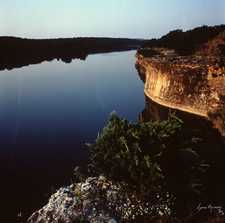 Dark Canyon-Brazos River
The main things that these rivers—some of them just sections of rivers—have in common is that they all flow within Texas, and that the country through which each one passes is typical of a distinctive part of the state. Those in the wide and varied region we call West Texas do share some historical memories from the eras of Indian warfare, northward trail drives, and so on, but the lands they drain, like the tone of their people's lives in the past and now, differ significantly, and in pictures and words we have tried to define some of those differences.
All the rivers too have suffered to some extent, often greatly, from modern mankind's manipulation and exploitation of their waters and their basins, and we have tried also to be honest about those matters.
Without the able help of a number of people, we would have had much skimpier knowledge to work with while producing the chapters and pictures in this book. It was heartening to find that every river and basin we chose to photograph and write about had its local enthusiasts, and that among these there was always at least one of scholarly bent who had delved deeply into the region's human and natural history and its lore. Some have written books that are listed in our bibliography. During much of my writing career I have been dependent on the insights of people like these, and I treasure them. They constitute one of the few remaining barriers against the deadly sameness that increasingly infests our world.
These friends willing to impart their knowledge and skills and perceptions to us are listed on the next three pages.
John Graves
2002
- Introduction
- The Canadian
- The Lower Neches
- The Pecos
- The Llano
- The Brazos Clear Fork
- The Upper Sabinal
- Bibliography
- Between Heaven and Texas
by Wyman Meinzer - Texas Trilogy: Life in a Small Texas Town
by Craig D. Hilis
- Book
- Texas Rivers
- Softcover
- 144 pages
- Publisher
- University of Texas Press 2002-10-01
- Purchase
- Purchase Book on Amazon.Com
- Website
- http://
- @